Introduction
Talc is one of the world’s most familiar minerals. Found in baby powders, cosmetics, pharmaceuticals, and industrial materials, it has shaped modern life in ways most people rarely notice. Its silky texture, so soft it has guided sculptors since antiquity, earned it the name talq in Arabic, meaning “pure.”1–3 But in recent decades, talc has been at the center of an increasingly complex question:
Can Talc Cause Cancer?
Understanding this question requires navigating the intersection of geology, industrial manufacturing, cellular biology, immunology, and epidemiology. This article synthesizes evidence from laboratory models, mechanistic studies, and population-level research to illuminate what we truly know, and where uncertainty still lies.
It is a hydrated magnesium silicate typically mined from natural deposits. The challenge is that talc deposits often occur near asbestos-containing rock, particularly tremolite and anthophyllite. Asbestos is a well-established carcinogen responsible for mesothelioma,lung cancer, and other malignancies.4–7
Even with rigorous purification standards, historical contamination of cosmetic talc with asbestos has been documented, providing one of the earliest reasons scientists began exploring the carcinogenic potential of talc. However, even asbestos-free talc raises biological questions.
Evidence from Animal Studies
Animal models cannot replicate cosmetic exposure exactly, but they offer key insights into biological plausibility.
Talc Into the Body Cavities
Several rat and mouse experiments have evaluated tumor formation following direct introduction of talc into the pleura or peritoneum.
In a large series of rodent studies reviewed by the US National Toxicology Program, female rats showed an increased incidence of adrenal medullary tumors and inflammatory lesions after high-dose talc inhalation.8
Hamster and mouse inhalation models produced chronic interstitial inflammation, though not always overt malignancy.9
Talc Inhalation and Lung Effects
Chronic talc inhalation in rodents leads to:
- Pulmonary fibrosis
- Immune dysregulation
- Increased cellular proliferation in bronchoalveolar regions.
Although tumors are inconsistent, the pathological environment resembles that induced by other low-grade particle carcinogens.8,10
Human Epidemiological Evidence
Epidemiological investigations into talc are inherently complex, reflecting the diversity of exposure pathways including cosmetic perineal application, occupational inhalation, and medical uses such as pleurodesis.
Perineal Talc Use and Ovarian Cancer
This is the most publicized and scientifically scrutinized association.
A pooled analysis from the Ovarian Cancer Association Consortium (65,000 women) reported a modest but statistically significant association between genital talc use and ovarian cancer.11
The association is strongest for serious ovarian carcinoma, the same subtype linked to inflammation-mediated pathways.
Other cohorts show weaker or null associations, but confounding factors (recall bias, exposure misclassification) limit certainty. Nevertheless, relative risks around 1.2–1.3 have been observed across multiple meta-analyses.12,13
Recall bias refers to a systematic error that occurs when study participants do not remember past exposures accurately, or when cases and controls recall exposures differently.
For example, individuals diagnosed with cancer may be more likely to remember or overreport prior talc use compared with healthy participants, which can distort the observed association between exposure and disease.
Exposure misclassification occurs when individuals are incorrectly categorized with respect to their true exposure status. This can result from vague exposure definitions, inaccurate self-reporting, or changes in product formulations over time.
In talc studies, misclassification may arise if participants cannot distinguish between talc-containing and non-talc powders or cannot accurately estimate frequency and duration of use.
Occupational Exposure and Lung Cancer
Workers in talc mining or milling are exposed to higher concentrations than consumers.
Talc and Mesothelioma
Cosmetic talc historically contaminated with asbestos has been implicated in several clusters of mesothelioma cases.
- In 2020 and 2022 case series, mineralogical analysis of lung tissue identified tremolite and anthophyllite fibers, suggesting long-term exposure from cosmetic talc products.16
Because mesothelioma is otherwise extremely rare, these findings have intensified scrutiny.17,18
Mechanism: What Happens at the Cellular Level?
Chronic Inflammation as a Carcinogenic Pathway
Mechanistic insights come from cell culture and animal experiments showing that talc particles can trigger a persistent inflammatory response.
- In rodent studies, intrapleural and intraperitoneal instillation of talc induces granulomatous inflammation, macrophage recruitment, and oxidative stress. Chronic inflammation is a known initiator of DNA damage and cell proliferation. A notable mouse study demonstrated that talc exposure increases reactive oxygen species (ROS) and upregulates pro-inflammatory cytokines such as IL-1β and TNF-α—molecules central to carcinogenic microenvironments.19–21
Particle Size and Surface Reactivity
Ultra-fine talc particles have higher surface area and can interact directly with cell membranes and intracellular pathways. In vitro research shows:
- DNA double-strand breaks in ovarian epithelial cells after high-dose talc exposure.22
- Activation of the NLRP3 inflammasome, a structure implicated in chronic inflammation and tumorigenesis.23
These findings parallel mechanisms seen in other mineral-induced cancers, including silica-associated lung disease.24
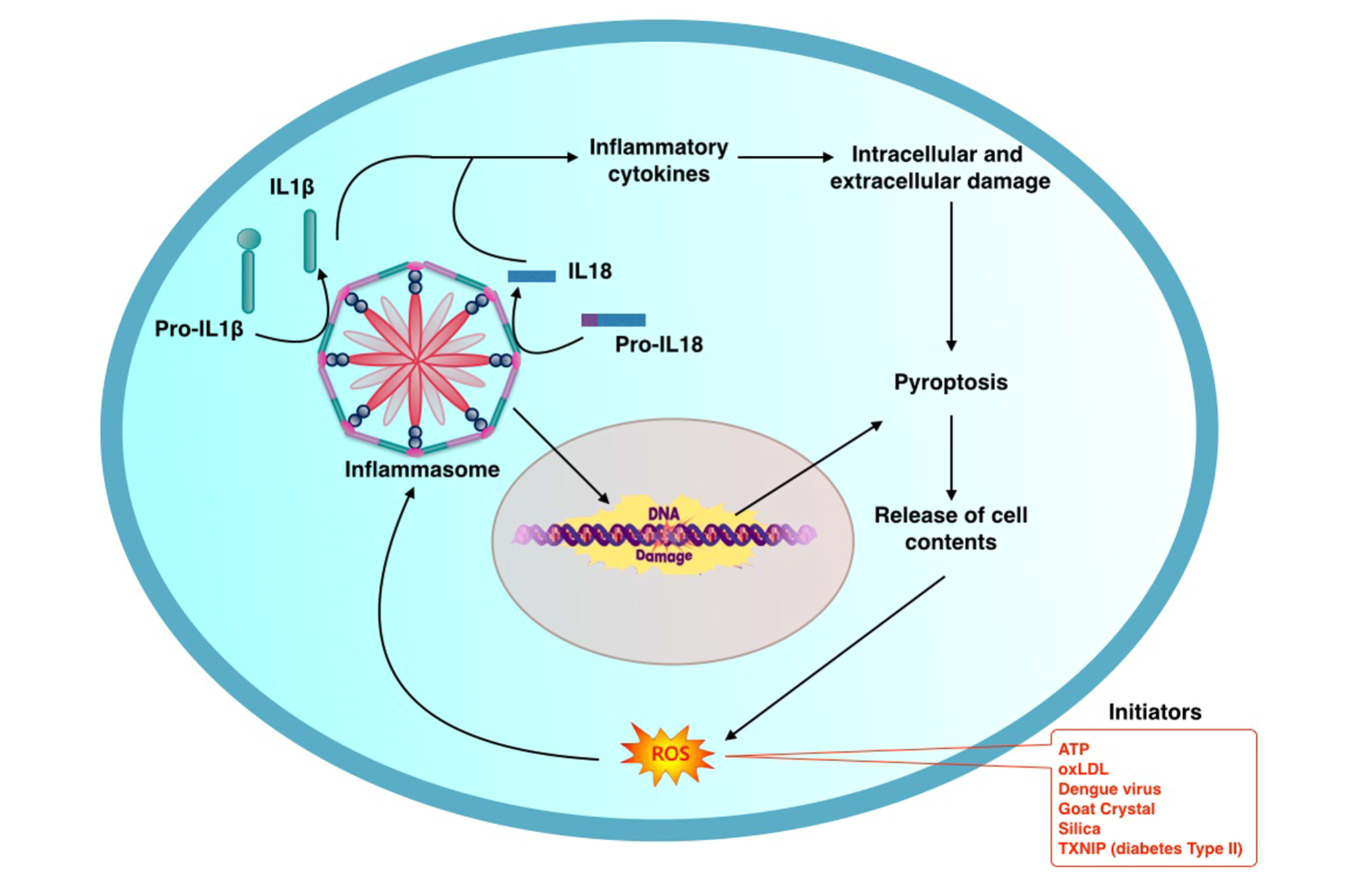
A general schematic of “inflammasome activation” illustrates how initiating stimuli (like talc,silica and others), induce the generation of reactive oxygen species (ROS), which subsequently trigger inflammasome activation and drive the downstream inflammatory cascade.25
The Special Case of Pleurodesis
In pleurodesis, medical-grade sterile talc is intentionally introduced into the pleural space to induce fibrosis in recurrent pneumothorax or malignant effusions.
Interestingly, long-term follow-up studies of patients receiving sterile talc pleurodesis show no increased mesothelioma or lung cancer incidence,likely because medical talc undergoes precise purification and involves a distinct exposure route and particle size distribution.
This natural experiment demonstrates that not all talc is biologically equal.26,27
Where Does This Leave Us?
What We Know
Talc can cause chronic inflammation, oxidative stress, and cellular injury—mechanisms consistent with carcinogenesis.
Asbestos contamination remains the most definitive risk factor, especially for mesothelioma.
Epidemiological links between perineal talc use and ovarian cancer are modest but persistent across many studies.
Occupational risks depend heavily on the purity of the talc also this one as well
What We Still Don’t Know
Whether pure cosmetic-grade talc is intrinsically carcinogenic.
The exact dose, duration, and particle characteristics required to induce malignant transformation in humans
How individual susceptibility including genetics, inflammation and microbiome, modulates risk
Conclusion
Talc occupies a unique scientific crossroads. For some, it is an everyday cosmetic ingredient; for others, a subject of litigation and regulatory debate. The evidence does not support universal alarm, but neither does it allow complacency. Instead, talc’s story is a reminder that even the most familiar substances warrant scientific vigilance.
As research evolves—from high-resolution mineral analysis to large-scale prospective cohorts—we are learning that cancer is rarely the result of a single exposure. It emerges from interactions between environment, inflammation, genetics, and time.
Talc’s potential carcinogenicity is not a closed case. But its unfolding narrative offers a powerful example of how science gradually illuminates risk, guiding safer choices for patients, consumers, and industries worldwide